


POLARIS A2 FACT SHEET
By Cliff Lethbridge
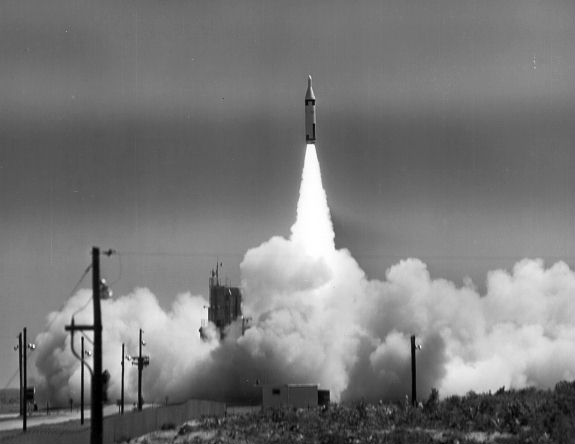
Polaris A2 Launch, Photo Courtesy U.S. Air Force
Classification: Fleet Ballistic Missile
Note: Fleet Ballistic Missiles are also referred to as Submarine-Launched Ballistic Missiles.
Length: 30 feet, 9 inches
Diameter: 4 feet, 6 inches
Range: 1,727 miles
Date of First Cape Canaveral Launch: November 10, 1960
Date of Final Cape Canaveral Launch: September 2, 1971
Number of Cape Canaveral Launches: 222
Designated UGM-27B, the Polaris A2 was under development in 1959 even before the Polaris A1 had been declared operational. Based on the basic Polaris A1 design, the Polaris A2 introduced a body which was lengthened about three feet to better fill out the tubes from which it would be launched. It also carried a new Hercules second stage engine with a glass filament-wound casing, as opposed to steel. This engine employed a rotary nozzle for thrust vector control, as did the Polaris A1 second stage engine. The Polaris A2 was initially carried aboard all five Ethan Allen Class submarines, which were the first of the Fleet Ballistic Missile (FBM) submarines to be built from scratch. The next generation of FBM submarines, beginning with SSBN 616 Lafayette, was called the Lafayette Class. The Lafayette Class filled out the initial U.S. Navy FBM fleet of 41 submarines. Although 31 Lafayette Class submarines were built, only the first eight were outfitted with Polaris A2 missiles. The remainder of the Lafayette Class submarines would eventually be outfitted with improved Polaris A3 and Poseidon missiles. Polaris A2 missiles remained in service until September, 1974, when the Ethan Allen Class submarine SSBN 611 John Marshall returned to port. Some remaining Polaris A2 missiles were later fired as targets during anti-missile tests. A Polaris A2 missile held the distinction of being the only FBM ever to carry a live nuclear warhead to its target. In the only FBM test of its kind, a Polaris A2 launched from SSBN 608 Ethan Allen fired a live nuclear warhead toward Christmas Island on May 6, 1962.