


SNARK FACT SHEET
By Cliff Lethbridge
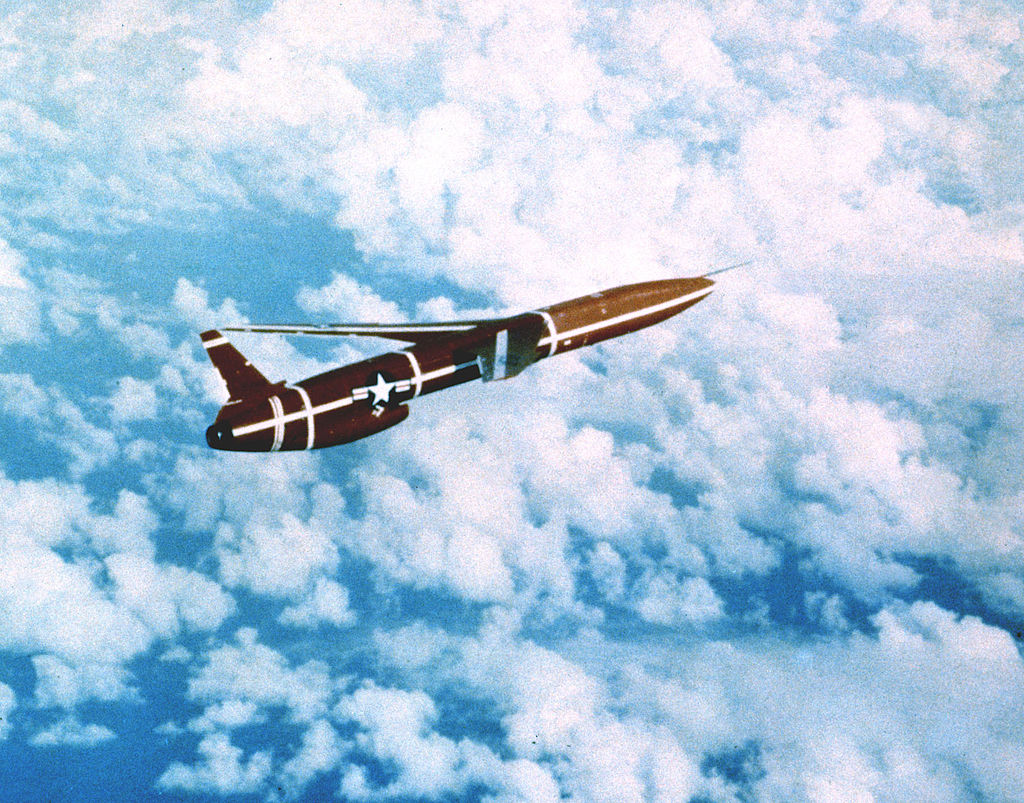
Snark Missile In Flight, Photo Courtesy U.S. Air Force
Classification: Surface-to-Surface Cruise Missile
Length: 75 feet, 11 inches
Diameter: 4 feet, 6 inches
Wingspan: 42 feet, 3 inches
Range: 6,325 miles
Date of First Cape Canaveral Launch: August 29, 1952
Date of Final Cape Canaveral Launch: December 5, 1960
Number of Cape Canaveral Launches: 97
Although the program was relatively short-lived, the Snark held the distinction of becoming the first operational U.S. intercontinental missile. The Snark also played an important role in the development of launch facilities and infrastructure at Cape Canaveral. Like the Atlas ICBM, the Snark cruise missile was born in October, 1945. At the time, the U.S. military began exploring several options for delivering nuclear weapons payloads over vast distances using unmanned vehicles. A development contract for a long-range winged cruise missile was awarded to prime contractor Northrup in January, 1946. However, budget restraints did not allow an early test version of the Snark, designated N-25, to fly until 1951. Nevertheless, development of the Snark progressed quickly. By the time an operational prototype of the Snark, designated N-69, was test flown for the first time on August 6, 1953, the missile’s range and payload had been doubled over specifications originally envisioned.
As the Snark continued to prove itself during flight testing, a high priority was placed on the program. It was not until 1954 that the U.S. determined that ballistic missiles could carry nuclear weapons between continents. This afforded the Snark a developmental edge. Alternately referred to as a pilotless bomber, the Snark cruise missile, designated SM-62A, had a large fuselage which could carry 26,000 pounds of liquid fuel. The Snark was powered in flight by a turbojet which could produce a 10,500-pound thrust. A Nortronics stellar inertial guidance system, using a star tracker, controlled the missile. This was the first time a guidance system of this type was employed on a missile. Although the Snark was originally designed to be carried into field operations by aircraft, this proved to be impractical. The missile itself weighed 15 tons, and required a portable launcher platform that had 16 wheels. This made only land transportation feasible.
Launches could be achieved just one hour after the Snark arrived at a suitable site. From its platform, zero-length launches were achieved by firing two solid-fueled boosters attached to the Snark. Each booster could produce a thrust of 130,000 pounds. Once these boosters were fired, the Snark began a smooth climb. After climbing steeply for about 50 seconds, the Snark leveled off for a high-altitude cruise at a speed of over 600 m.p.h. The star tracker provided constant position updates to the stellar inertial guidance system, which was designed to place the Snark on a ballistic trajectory toward its target. Upon approach, a warhead was ejected from the main body, and continued to fall toward its target. Once the warhead was ejected, the main body of the Snark pitched upward violently and broke up.
The Snark could carry a nuclear payload of up to 20 megatons, and could approach its target from any direction at any height within its operational limits. The missile could also take evasive action without losing guidance accuracy. But perhaps the most remarkable feature of the Snark was its ability to fly missions of up to 11 hours and return for a landing. Since the Snark was only destroyed if its warhead needed to impact a target, the missile itself could be flown again and again as conditions warranted. Although it did not employ landing gear, the Snark was able to safely skid to a landing on any flat, level surface. Indeed, many Snark missiles made successful landings at Cape Canaveral, the first missiles to be recovered at the Cape in this way. It is perhaps the most enduring legacy of the Snark that to this day, the runway at Cape Canaveral is still referred to as the “skid strip” in memory of the Snark missiles that “skidded” along its surface many years ago.
Snark missiles, by then re-designated N-69E, were declared operational in April, 1957 for the 556th Strategic Missile Squadron activated at Patrick Air Force Base, just south of the Cape. The squadron was later deployed at Presque Isle, Maine. This lone Snark squadron was renamed the 702nd Strategic Missile Squadron in July, 1959. In 1961, the squadron was deactivated as Snark missiles were withdrawn from service in the wake of the Atlas ICBM. With an operational life of only four years, the Snark still remains one of the best remembered programs in the history of the Cape. Not only will the “skid strip” name endure in honor of the missile, so will tales of “Snark infested waters” stemming from Snark failures. While the term may not do justice to what was an advanced cruise missile in its day, references to “Snark infested waters” remain one of the best known anecdotal ties to the history of early operations at Cape Canaveral.
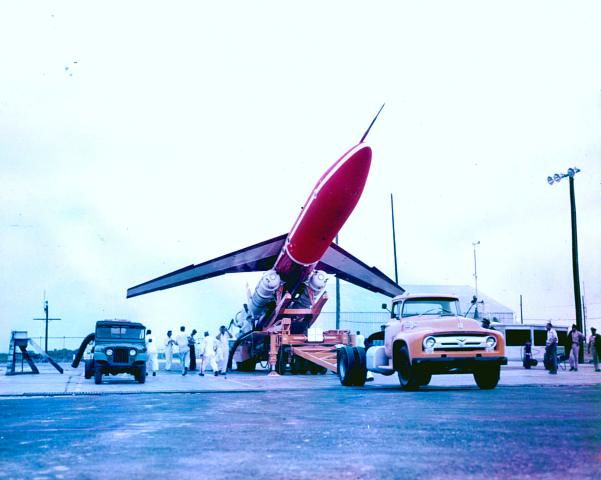
Snark Missile On Launcher, Photo Courtesy U.S. Air Force